Quick answer
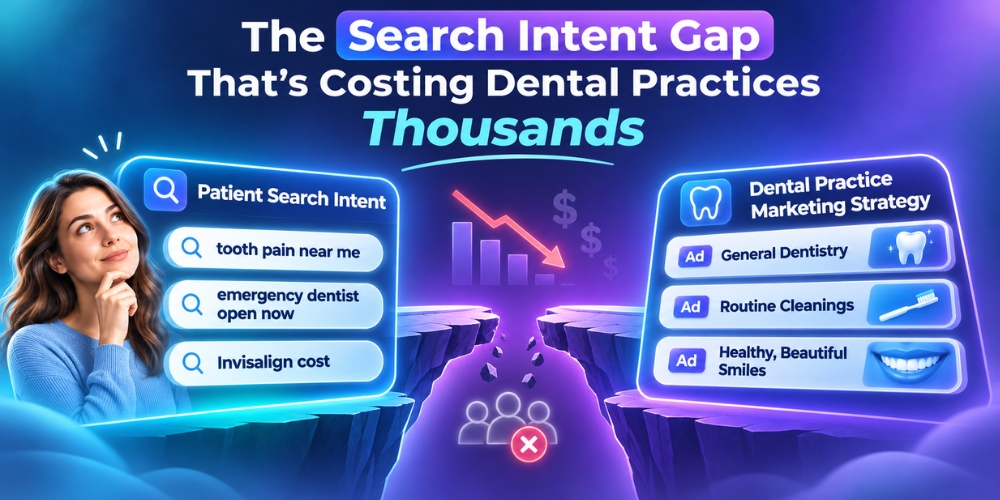
The search intent gap in dental marketing is the mismatch between what patients actually want when they search and what your website delivers. Closing it means matching every page to a specific query so informational, commercial, transactional, and local searches each get the exact answer that turns a click into a booked appointment.
Key takeaways
- Search intent falls into four buckets: informational, commercial, transactional, and local. Each needs a different page.
- Clinical excellence does not automatically translate into search visibility, so great dentists often lose to average ones online.
- Mismatched pages waste ad spend, bury booking paths, and quietly leak new-patient revenue every month.
- Audit your service pages, Google Business Profile, and AI-overview readiness to find your own intent gap.
- Answer-first content plus clear booking paths and local landing pages close the gap and lift conversions.
Quick question: when was the last time you chose a restaurant whose website made you squint, hunt for a phone number, and guess whether it was even open? Painful, right? Now here is the uncomfortable twist. Thousands of skilled dentists are doing the exact same thing to their patients every single day, and they have no idea it is happening. The clinical work is excellent. The online experience? It is quietly sending patients straight to the competitor down the street.
Here is the good news, and there is plenty of it. This problem is completely fixable, often faster and cheaper than most practice owners expect. The culprit has a name: the search intent gap. Once you understand it, you can start plugging a revenue leak you probably did not know existed. Let us walk through exactly what it is, why it hurts, and how to close it.
The Search Intent Gap, Explained in One Minute
The search intent gap is the distance between what a patient actually wants when they type a query and what your website gives them in return. Close that distance and clicks turn into appointments. Leave it open and even heavy traffic goes nowhere. This single mismatch is the quiet engine behind why dental websites don't convert.
What 'search intent' actually means for a dental practice
Search intent is the real goal behind a search. Someone typing "why does my jaw click" wants an explanation, not a price list. Someone typing "book emergency dentist tonight" wants a button, not a 900-word history of your practice. Dental search intent is simply reading that goal correctly and answering it directly. Modern search engines reward pages that satisfy intent fast and completely, which is why intent-matching is the backbone of dental SEO keyword intent.
How the gap quietly drains new-patient revenue
The gap rarely announces itself. There is no error message when a page fails to match intent. Visitors simply leave, and leaving is invisible in your daily routine. Interestingly, dentistry already understands this pattern in a clinical context. Research on the evidence-to-practice gap shows that even strong guidelines fail to change outcomes when they are not implemented in a usable way, as described in work on the implication gap in evidence-based dentistry. Your website has the same problem. Good intentions that are poorly delivered change nothing.
A quick self-test: does your site answer or just describe?
Open your homepage and your top service page. Read the first two sentences of each. Do they answer a question a patient is actively asking, or do they describe how wonderful your office is? If it is mostly a description, you have an intent gap. Answer-first pages win; brochure pages lose. That is the whole test, and it takes sixty seconds.
The Four Types of Patient Search Intent (and What Each Wants)
There are four core types of patient search intent, and each one wants something different. Treat them all the same and you will frustrate most of your visitors. Map a dedicated response to each and you capture patients at every stage of their decision.
Informational: 'why does my tooth hurt at night'
Informational searchers want understanding, not a sales pitch. They are often anxious and in the early research stage. A clear, reassuring explanation that answers the question and gently points toward next steps builds trust long before they are ready to book. Skip the answer and you lose them before they ever consider you.
Commercial: 'best Invisalign dentist near me'
Commercial searchers are comparing options and weighing providers. They want proof: credentials, outcomes, reviews, before-and-after results, and a sense of what makes you different. This is the research phase of dental patient search behavior, and it is where most practices underinvest. Thin, generic service pages lose here every time.
Transactional: 'book emergency dentist'
Transactional searchers are ready to act right now. They want to schedule, call, or confirm availability with the least friction possible. If your page makes them hunt for how to book, you have lost a patient who was literally reaching for their wallet. Every extra click here costs money.
Local and navigational: 'dentist open Saturday near me'
Local searchers want specifics tied to place and time: hours, location, parking, insurance, directions. This is the heart of local SEO for dentists. If your Google Business Profile and local pages do not answer these instantly, patients scroll to someone who does. For a deeper look at where these searches now happen, see AI search vs Google search: where patients are finding dentists today.
The fastest win most practices miss
Create one page per intent type for your highest-value service. An explainer for the researchers, a proof-rich page for the comparers, and a frictionless booking path for the ready-to-act. One service, three doors, far more patients walking through them.
Why Great Dentists Still Lose to Average Ones Online
Great dentists lose to average ones online because clinical skill and search visibility are two completely different competencies. Being an excellent clinician does not make your website easy to find or easy to act on. The practice that communicates clearly online usually wins the patient, even when its chairside work is simply adequate.
Clinical excellence doesn't translate to search visibility
Patients cannot evaluate your clinical skill from a search result. They can only evaluate what they see: your reviews, your photos, your answers, and how fast you respond. Those signals decide the click. The best hands in town mean nothing if no one can find or trust them online. We explore this fully in why great dentists sometimes lose to average dentists online.
The evidence-to-implementation gap mirrors the marketing gap
Dentistry has studied this exact disconnect in clinical care. The field knows that integrating expertise with real-world systems is what actually improves results, a principle central to evidence-based dental care. Research on closing the evidence-practice gap through web-based tools shows that implementation, not just knowledge, drives outcomes. Your marketing works the same way. Knowing you are good is not enough; the system has to deliver that quality to patients.
What patients secretly judge before they ever call
Patients form fast judgments from tiny cues long before they dial your number. Review tone, response speed, photo quality, and page clarity all shape their decision. Perceived service quality strongly predicts whether a patient returns and refers, as shown in research on dental service quality and revisit intention. Learn what those cues are in what patients secretly judge before booking a dentist.
How the Gap Costs Practices Thousands
The search intent gap costs thousands because every mismatched page wastes attention you already paid to earn. Whether that attention came from ads or organic effort, a page that does not match intent converts far below its potential, and the losses compound month after month.
Mismatched pages mean wasted ad spend and lost clicks
When you send paid traffic to a page that does not match the searcher's intent, you pay for the click and get nothing back. A "book emergency dentist" ad that lands on a generic homepage is money set on fire. Matching the landing page to the exact query is one of the single biggest levers for dental marketing ROI.
The hidden cost of making patients call instead of book
Forcing every patient to call creates friction that silently kills conversions, especially after hours when your phone goes unanswered. Many patients will not leave a voicemail; they simply book elsewhere. The math adds up quickly, and we break it down in the hidden cost of making patients call instead of book online.
Calculating your intent-gap revenue leak*
Estimate it yourself. Take your monthly website visitors, apply a realistic conversion rate, and compare that to what a well-matched site could achieve. The difference, multiplied by your average new-patient value, is your leak.
| Scenario | Monthly visitors | Conversion | New patients |
|---|---|---|---|
| Intent gap present | 1,000 | 1.5% | 15 |
| Gap closed | 1,000 | 4% | 40 |
| Monthly difference | - | - | 25 |
Twenty-five additional patients a month, multiplied by your average case value, is the number quietly leaving your practice. Those figures are illustrative, but the pattern is very real.
Diagnosing Your Own Search Intent Gap
You diagnose your search intent gap by auditing three things: your service pages, your local signals, and your readiness for modern search formats. Each reveals where patient expectations and your delivery drift apart, and each is fixable once you see it clearly.
Map every service page to a specific query
List your service pages in one column and the exact query each should answer in another. If a page tries to answer five different questions, it answers none of them well. One page, one dominant intent. This simple exercise exposes most gaps in an afternoon and gives you an instant to-do list.
Audit your Google Business Profile and local signals
Check that your hours, services, categories, photos, and reviews are complete, accurate, and current. Local searchers rely on these signals heavily, and incomplete profiles lose to complete ones consistently. This is foundational to local SEO for dentists and often the fastest fix available.
Check AI-overview and voice-search readiness
Patients increasingly ask questions in full sentences and get answers from AI summaries. Pages with clear, direct, answer-first content are far more likely to be surfaced. Watch your phrasing too; one vague word can quietly repel patients, as we cover in the most expensive word on your dental website.
Closing the Gap: A Practical Framework
You close the search intent gap by matching content format to intent, adding clear booking paths, building trust content, and creating focused local pages. Here is the framework, step by step.
Match format to intent
Lead every page with the direct answer the searcher wants, then add detail. Informational queries get clear explanations, transactional queries get instant action. Format follows intent, not preference.
Add clear booking paths
Place an obvious, repeated path to schedule on every transactional page. Online booking removes friction and captures patients outside office hours, exactly when the phone cannot.
Build trust content for comparers
Satisfy commercial research with real proof: credentials, outcomes, reviews, and honest answers to the questions patients actually ask before choosing a provider.
Create focused local pages
Build pages that answer location, hours, insurance, and directions clearly so navigational searchers get everything they need to choose you with confidence.
Use these
- Answer-first page openings
- One dominant intent per page
- Visible, repeated booking buttons
- Real reviews, photos, and credentials
- Complete, accurate local profiles
Avoid these
- Brochure pages that only describe
- One page targeting five queries
- Phone-only contact with no booking
- Stock photos and vague claims
- Outdated hours and thin profiles
Measuring Success After You Close the Gap
You measure success by tracking the actions that signal real patient demand, not vanity metrics. Traffic feels good, but booked consultations pay the bills. Focus your attention where revenue actually lives.
The marketing numbers that actually matter
Track conversion rate, cost per new patient, and the revenue tied to each channel. These numbers tell the truth about performance while raw pageviews mislead. We go deeper in the marketing numbers that actually matter.
Tracking consultation requests, not just traffic
Count the booking requests, form fills, and calls that turn into appointments. A page with modest traffic and strong conversion beats a popular page that converts nobody. Measure outcomes, not applause, and let the data guide your next improvement.
When to bring in a dental marketing partner
Bring in a partner when the gap is clear but your time, tools, or team cannot close it fast enough. The right partner moves faster and avoids expensive trial and error, turning insight into booked patients. This is exactly where expert help pays for itself quickly.
How Digital Presence Matters helps you close the gap
Digital Presence Matters specializes in closing the search intent gap for dental practices from end to end. We align your website, content, and local signals so every type of patient search leads straight to a booked appointment. Our work spans professional video creation that showcases your team and builds instant trust, social media marketing that keeps you visible, and targeted digital advertising that sends each click to a page built for that exact intent. We also handle technical and local SEO, branding that sets you apart, and website enhancement that turns visitors into patients. The result is a seamless system where clinical excellence finally meets digital visibility, protecting the revenue your current site quietly leaks. If you are ready to stop losing patients to practices with better marketing, reach out at Info@digitalpresencematters.com or call (925) 940-0705 and let us map your gap together.
Frequently asked questions
Search intent in dental marketing is the real goal behind a patient's search. It falls into four types: informational (learning), commercial (comparing providers), transactional (ready to book), and local or navigational (finding a nearby open office). Matching each page to the right intent is what turns searchers into booked patients instead of lost clicks.
Most dental websites fail to convert because they describe the practice instead of answering what the visitor actually wants. If a ready-to-book patient lands on a brochure-style page, or a researcher gets a sales pitch, the intent gap pushes them to a competitor. Friction like phone-only contact and buried booking paths makes it worse, especially after hours.
Start by listing the questions patients ask at the front desk and in the chair, then group them by intent. Use Google's autocomplete, related searches, and your own analytics and call logs to see real phrasing. Map each query to a specific page so every search has a clear, direct destination that answers it fully.
Yes. Search engines reward pages that satisfy a searcher's intent quickly and completely, so intent-matched pages tend to rank higher and hold rankings longer. Answer-first content also improves your chances of appearing in AI overviews and voice results, where clear, direct answers are favored over vague, descriptive marketing copy.
It varies, but the leak adds up fast. If a site converts 1.5 percent instead of a well-matched 4 percent on 1,000 monthly visitors, that is roughly 25 fewer new patients each month. Multiply that by your average new-patient value and the annual cost often reaches well into the tens of thousands of dollars in missed cases.
Both, but on separate pages matched to intent. Informational pages should educate anxious researchers and build trust, while transactional pages should remove friction and make booking instant and obvious. Trying to do both on one page usually does neither well, so create dedicated pages for each stage of the patient journey to maximize conversions.
- Match every page to one clear patient intent. Answer first, then describe, and watch conversions climb.
- Clinical skill wins in the chair, but visibility and clarity win the search. Invest in both to grow sustainably.
- Measure booked consultations, not pageviews. The numbers that pay your bills are the only scoreboard that matters.
Disclaimer
*All insights in this article are provided for informational and marketing purposes only and should not be taken as professional, clinical, legal, or financial advice. Revenue figures and conversion rates shown are illustrative examples, not guarantees. Results vary by practice, market, and implementation. Consult qualified professionals before making business decisions based on this content.