If Your Website Is “Fine,” Why Isn’t It Producing Results?
Let’s start with an uncomfortable reality.
Thousands of businesses are losing leads, sales, and opportunities every day because of websites they believe are perfectly acceptable.
The homepage looks professional. The logo is polished. The colors match the brand. The contact page works. Everything appears normal.
Yet the phone isn’t ringing as often as expected.
The contact forms remain untouched.
Traffic arrives but never converts.
And despite investing time and money into the website, business growth remains frustratingly slow.
Here’s the problem: looking good and performing well are not the same thing.
A website can appear modern while quietly failing at its most important job—turning visitors into customers.
In today’s digital landscape, consumers make decisions in seconds. They expect speed, clarity, trust, convenience, and value immediately. If your website cannot deliver those elements, visitors leave. Often, they leave without giving you a second chance.
The most dangerous websites are not the obviously bad ones.
They’re the ones that seem good enough.
Because when a website looks acceptable, business owners rarely question its performance. They assume the problem lies elsewhere—market conditions, competition, pricing, or advertising.
In reality, the website itself may be the bottleneck.
This article explores the most common reasons websites fail despite appearing functional, and what businesses can do to transform their websites into powerful growth engines.
A Website Is More Than a Digital Brochure
Many businesses still approach websites as online brochures.
They create a few pages, add company information, upload some images, and consider the project complete.
Unfortunately, modern consumers expect much more.
Today’s website must serve as:
- A sales tool
- A marketing platform
- A lead generation system
- A trust-building asset
- A customer service resource
- A conversion engine
Every page should have a purpose.
Every element should guide visitors toward an action.
Whether that action is booking a consultation, requesting a quote, making a purchase, or scheduling a call, the website should actively support business objectives.
If a website simply exists without driving measurable outcomes, it is not performing at its full potential.
Visitors Decide Faster Than You Think
One of the biggest misconceptions about websites is that users carefully evaluate every page.
They don’t.
Research consistently shows that visitors form impressions almost instantly.
Within seconds, users determine whether they trust a website, understand its purpose, and believe it can solve their problem.
If any of those questions remain unanswered, they often leave.
Factors influencing first impressions include:
- Visual design
- Page speed
- Navigation clarity
- Professional appearance
- Mobile usability
- Content quality
Businesses frequently focus on what they want to say instead of what visitors need to know.
The result is confusion.
And confused visitors rarely become customers.
A high-performing website immediately communicates value, credibility, and direction.
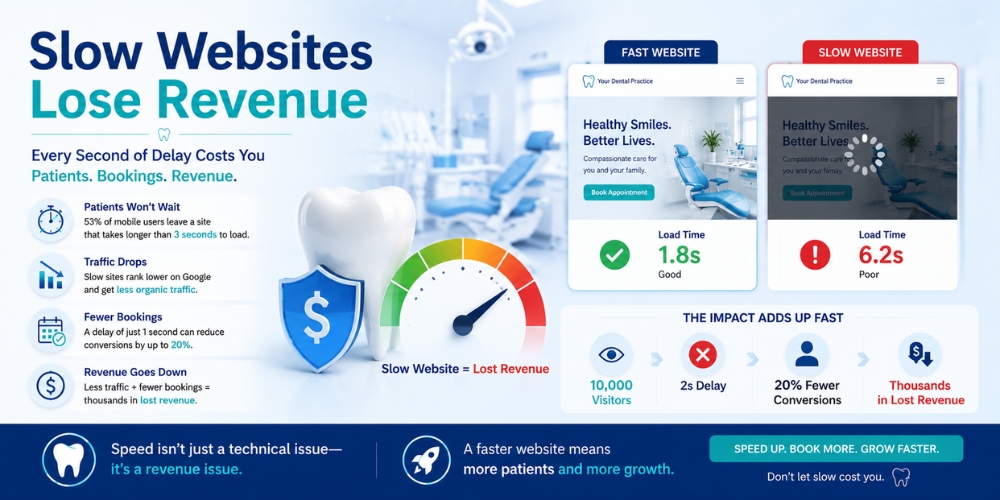
Slow Websites Lose Revenue
Speed is no longer a luxury.
It is an expectation.
Modern consumers expect websites to load quickly across all devices. Every additional second of delay increases the likelihood of abandonment.
Slow websites create multiple problems:
- Higher bounce rates
- Lower engagement
- Reduced conversions
- Poor user experience
- Lower search rankings
Google also considers page speed when evaluating websites.
This means slow performance affects both user satisfaction and search engine visibility.
Common causes of slow websites include:
- Large image files
- Excessive plugins
- Poor hosting
- Unoptimized code
- Unnecessary scripts
Improving load speed often produces immediate gains in user engagement and conversion rates.
A fast website respects the visitor’s time and builds trust from the first interaction.
Mobile Optimization Is No Longer Optional
More than half of web traffic now comes from mobile devices.
Despite this reality, many websites still prioritize desktop experiences.
This creates a significant problem.
A website that looks great on a desktop monitor may become frustrating on a smartphone.
Users encounter:
- Tiny text
- Difficult navigation
- Slow loading times
- Broken layouts
- Hard-to-click buttons
When mobile experiences suffer, conversions suffer.
Google’s mobile-first indexing also means mobile performance directly influences search visibility.
A truly effective website functions seamlessly across all devices.
Every page, image, button, and form should deliver a smooth user experience regardless of screen size.
Mobile optimization is not merely a technical requirement.
It is a competitive necessity.
Poor Navigation Creates Friction
Imagine walking into a store where nothing is labeled.
Finding products would become frustrating almost immediately.
The same principle applies to websites.
Visitors should never struggle to find information.
Unfortunately, many websites overwhelm users with complicated menus, unclear page structures, and excessive options.
Effective navigation helps visitors quickly locate:
- Services
- Products
- Pricing information
- Contact details
- Frequently asked questions
- Booking options
The easier it is for users to navigate, the more likely they are to stay engaged.
Good navigation reduces friction.
Reduced friction increases conversions.
Simple often outperforms complicated.
Weak Messaging Hurts Conversions
Many websites fail because they focus too heavily on the business rather than the customer.
Visitors are not primarily interested in company history.
They want solutions.
They want benefits.
They want answers.
Strong website messaging addresses key questions:
- What do you offer?
- Who do you help?
- Why should someone choose you?
- What problem do you solve?
- What should visitors do next?
Clear messaging creates confidence.
Vague messaging creates uncertainty.
Businesses often assume visitors understand industry terminology, but many users do not.
Simple, direct communication consistently performs better than overly technical language.
Clarity wins.
Lack of Trust Signals Reduces Action
Trust plays a major role in online decision-making.
Before submitting a form or making a purchase, users look for evidence that a business is credible.
This is where trust signals become essential.
Effective trust elements include:
- Customer reviews
- Testimonials
- Certifications
- Awards
- Case studies
- Security indicators
- Professional photography
Without trust signals, visitors may hesitate.
Even if your products or services are excellent, uncertainty can prevent action.
People naturally seek reassurance before making decisions.
A website should actively provide that reassurance.
Trust converts visitors into customers.
Your Calls-to-Action Might Be Too Weak
One of the simplest reasons websites fail is the absence of effective calls-to-action.
Visitors need direction.
Without clear guidance, they may leave without taking any meaningful action.
Common calls-to-action include:
- Contact Us
- Book a Consultation
- Request a Quote
- Schedule a Demo
- Get Started
- Call Now
However, placement matters just as much as wording.
Calls-to-action should appear throughout the website, not only on the contact page.
Visitors should never have to search for the next step.
A website should continuously guide users toward conversion opportunities.
The easier the process becomes, the higher the likelihood of engagement.
SEO Problems Can Make You Invisible
Even the most attractive website cannot generate results if nobody finds it.
Search Engine Optimization (SEO) helps businesses improve visibility in search results.
Without SEO, websites often struggle to attract qualified traffic.
Important SEO components include:
- Keyword optimization
- Technical SEO
- Local SEO
- Content creation
- Internal linking
- Meta descriptions
- Mobile performance
Relevant keywords such as website optimization, digital marketing, SEO services, local SEO, website design, lead generation, conversion rate optimization, and online visibility can help businesses connect with potential customers.
SEO is not about manipulating search engines.
It is about making content accessible, relevant, and valuable.
Visibility creates opportunity.
Without visibility, growth becomes significantly harder.
Content Matters More Than Ever
Content remains one of the most influential factors in website performance.
Visitors seek information before making decisions.
Quality content helps educate, persuade, and convert.
Effective content can include:
- Service pages
- Blog articles
- FAQs
- Videos
- Case studies
- Resource libraries
Content also supports SEO efforts by helping search engines understand your expertise and relevance.
Businesses that consistently create useful content often outperform competitors that rely solely on static websites.
Good content builds authority.
Authority builds trust.
Trust drives conversions.
Analytics Reveal the Real Story
Many businesses assume their websites are performing well because they occasionally receive inquiries.
But assumptions can be misleading.
Website analytics provide objective insights into user behavior.
Key metrics include:
- Traffic volume
- Bounce rate
- Conversion rate
- Time on site
- Traffic sources
- User pathways
These metrics reveal where visitors engage, where they leave, and what improvements may increase performance.
Data removes guesswork.
The most successful businesses continuously analyze and refine their websites based on measurable results.
Optimization is not a one-time activity.
It is an ongoing process.
Why “Good Enough” Is Often the Biggest Problem
The phrase “good enough” has quietly limited countless businesses.
A website that is completely broken gets fixed quickly.
A website that is merely underperforming often remains unchanged for years.
This creates hidden costs.
Lost leads.
Missed opportunities.
Reduced visibility.
Lower revenue potential.
Because these losses happen gradually, many businesses fail to recognize their impact.
The goal should not be having a website that looks acceptable.
The goal should be having a website that actively supports growth.
Performance matters more than appearance alone.
Results matter more than assumptions.
How Digital Presence Matters Helps Businesses Turn Websites Into Growth Engines
Many businesses understand their websites need improvement but struggle to identify exactly what is wrong.
This is where Digital Presence Matters provides strategic value.
Rather than focusing only on esthetics, Digital Presence Matters helps businesses build complete digital ecosystems designed to attract, engage, and convert customers.
Website enhancement services focus on improving user experience, site performance, conversion optimization, navigation, messaging, and overall effectiveness. The goal is not simply creating attractive websites but building platforms that produce measurable business results.
SEO services help businesses increase online visibility through keyword optimization, technical improvements, local SEO strategies, content development, and search engine best practices.
Beyond website optimization, Digital Presence Matters offers professional video creation services that help businesses communicate their value more effectively. Video content strengthens engagement, builds trust, increases retention, and creates stronger emotional connections with audiences.
Their social media marketing solutions help brands maintain visibility across multiple platforms while fostering audience engagement and brand recognition.
Digital advertising services provide targeted opportunities to reach qualified prospects through strategic campaigns designed to generate leads, conversions, and growth.
Branding services ensure consistency across all customer touchpoints, helping businesses establish stronger identities and greater market recognition.
By integrating website enhancement, SEO, video marketing, social media management, branding, and digital advertising, Digital Presence Matters helps businesses move beyond simply having a website and begin leveraging it as a powerful growth tool.
The result is improved visibility, stronger engagement, better conversions, and a more effective digital presence.
Conclusion
A website can look impressive and still fail to deliver results.
Appearance alone does not guarantee performance.
Modern websites must provide speed, clarity, trust, usability, visibility, and conversion opportunities. Every element should contribute to business objectives while creating positive user experiences.
When websites fail, the causes are often hidden beneath the surface. Slow loading times, poor messaging, weak calls-to-action, mobile usability issues, SEO challenges, and trust deficiencies can quietly reduce effectiveness.
The good news is that every one of these problems can be addressed.
Businesses willing to evaluate their websites objectively and invest in strategic improvements position themselves for stronger growth, better lead generation, and increased customer acquisition.
A successful website is not one that simply looks good.
It is one that consistently delivers results.
Contact Digital Presence Matters
Email: Info@digitalpresencematters.com
Phone: (925) 940-0705
Remember
- A visually attractive website is valuable, but performance, usability, and conversions matter even more.
- Regularly review analytics and user behavior to identify opportunities for improvement.
- Small website enhancements can create significant long-term gains in visibility, leads, and revenue.
Disclaimer
The information provided in this article is intended for informational and marketing purposes only. It should not be considered legal, financial, business, technical, or professional advice. Results may vary depending on industry conditions, competition, implementation quality, and individual business circumstances. Always consult qualified professionals before making significant business, marketing, or technology decisions.