The Best News for Dental Practices? Patients Still Need Dentists – They Just Don’t Behave Like They Used To
What if the biggest problem with your dental marketing strategy is not your budget, your website, your competition, or even your SEO?
What if the problem is that you are still trying to move patients through a marketing funnel that no longer reflects reality?
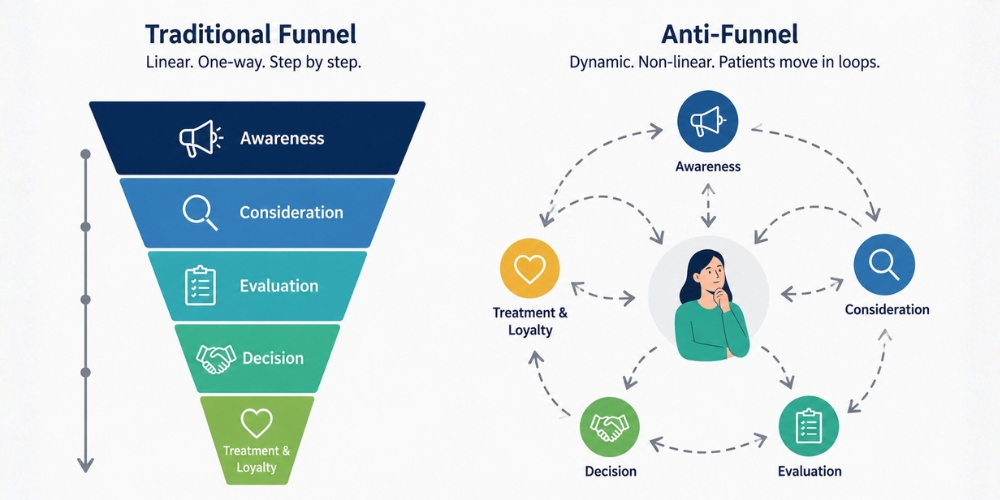
For years, dental marketing followed a familiar formula: attract attention, generate interest, create consideration, convert appointments, retain patients.
Simple.
Predictable.
Comforting.
Unfortunately, modern patient behavior has become far less linear.
Patients in 2026 do not move neatly from awareness to booking. They jump between platforms. They compare providers. They watch videos. They read reviews. They ask AI tools questions. They visit websites, leave, return later, and sometimes schedule without speaking to anyone.
The traditional funnel has not disappeared.
It has evolved.
Modern patient acquisition looks less like a funnel and more like an ecosystem.
This is the anti-funnel.
Practices that understand this shift are growing faster, creating stronger patient relationships, and building more sustainable acquisition systems.
The practices still relying on outdated assumptions are wondering why traffic is increasing while appointments remain inconsistent.
Understanding how patients actually book today changes everything.
What Is the Anti-Funnel?
The anti-funnel is not the absence of structure.
It is recognition that patient decisions are no longer linear.
Instead of moving step by step, patients enter and exit the decision process repeatedly.
A typical modern booking journey may involve:
- Discovering a practice through search
- Reading reviews
- Leaving without action
- Watching social media videos
- Returning weeks later
- Comparing competitors
- Visiting the website again
- Booking online
That sequence rarely follows a straight line.
Every interaction influences the final decision.
Dental practices must optimize for the entire experience.
Why the Traditional Funnel Became Less Reliable
Traditional funnels assumed businesses controlled the customer journey.
Today, patients control discovery.
They decide:
- Where to search
- When to engage
- How to compare
- When to schedule
Patients have more information and more options.
This creates more complexity.
The practices growing fastest are not trying to force behavior.
They are adapting to it.
Discovery Happens Everywhere
The first patient interaction rarely happens where practices expect.
Discovery may begin through:
- Google search
- Google Maps
- YouTube
- Online reviews
- AI-assisted search
- Referral conversations
- Website content
This means every digital touchpoint matters.
Visibility is no longer isolated.
Your website is not competing with another website.
It is competing with every digital experience patients encounter.
Search Is Becoming Intent-Driven
Patients rarely search broadly anymore.
Instead of typing:
“dentist”
they search:
- best cosmetic dentist near me
- emergency dentist open now
- Invisalign consultation
- teeth whitening results
Intent matters.
High-intent searches often produce stronger conversions.
Dental SEO in 2026 is increasingly focused on matching patient intent rather than maximizing traffic volume.
Trust Happens Before Contact
Many practices assume trust begins during consultations.
In reality, trust often develops earlier.
Patients evaluate:
- Reviews
- Website quality
- Branding
- Social proof
- Educational content
- Video
If confidence does not develop digitally, consultations may never happen.
The anti-funnel prioritizes trust-building before direct interaction.
Reviews Have Become Decision Accelerators
Patients increasingly use reviews as shortcuts.
Strong review profiles reduce uncertainty.
Important review factors include:
- Quantity
- Recency
- Quality
- Response activity
Reviews do more than influence perception.
They influence momentum.
Better trust often means faster booking decisions.
Patients Expect Frictionless Booking
Convenience has become a competitive advantage.
Modern booking expectations include:
- Online scheduling
- Mobile optimization
- Fast responses
- Clear instructions
Every unnecessary step creates drop-off risk.
The anti-funnel removes barriers.
Practices that simplify booking often outperform larger competitors.
Video Is Replacing Traditional Introduction
Patients increasingly want to see providers before meeting them.
Video supports:
- Familiarity
- Trust
- Education
- Engagement
Effective dental video content includes:
- Team introductions
- Procedure explanations
- Office tours
- Educational content
Patients who feel familiar often schedule with more confidence.
Educational Content Creates Momentum
Modern patients research before they contact.
Educational content helps answer questions early.
Strong topics include:
- Dental implants
- Veneers
- Invisalign
- Smile makeovers
- Preventive dentistry
Content should educate rather than overwhelm.
Useful information supports decision-making.
Website Experience Determines Progression
Traffic alone does not create growth.
The experience matters.
High-performing websites prioritize:
- Mobile responsiveness
- Speed
- Clear calls to action
- Easy navigation
- Service-specific pages
Patients evaluate professionalism quickly.
Website friction weakens momentum.
Social Media Is No Longer Optional Visibility
Patients increasingly evaluate practices socially.
- Brand familiarity
- Educational engagement
- Community presence
- Trust development
Consistent posting reinforces visibility.
Practices do not need to dominate every platform.
They need consistency.
Branding Makes Patients Remember You
Branding is often misunderstood.
Strong dental branding communicates:
- Professionalism
- Trust
- Clarity
- Personality
Branding reduces comparison pressure.
Patients remember practices that feel distinct.
Recognition supports conversion.
SEO Has Expanded Beyond Rankings
SEO in 2026 supports discoverability across multiple channels.
Strong SEO includes:
- Local SEO
- Service content
- Keyword optimization
- Technical performance
- Search intent alignment
Relevant keywords may include:
- dentist near me
- cosmetic dentistry
- family dentist
- emergency dental care
- dental implants
SEO should attract the right patients.
Not random clicks.
Multi-Touch Attribution Is the New Reality
Patients rarely convert from one interaction.
Modern journeys often involve multiple touchpoints.
Examples include:
- Search → Reviews → Website
- Social → Website → Booking
- Video → Search → Appointment
This means attribution becomes more complex.
Practices should evaluate entire journeys.
Not isolated channels.
Automation Supports Modern Patient Expectations
Automation improves experience.
Useful systems include:
- Appointment reminders
- Review requests
- Follow-up campaigns
- Recall systems
Automation reduces friction.
Better experiences support growth.
Data Should Drive Decisions
Successful practices monitor:
- Conversion rates
- Website engagement
- Appointment requests
- Review growth
- Cost per lead
Measurement improves marketing quality.
Data supports smarter investment.
Why Practices Growing Faster Think Differently
Fast-growing practices share common characteristics.
They:
- Build trust digitally
- Simplify booking
- Create content
- Use video
- Invest in SEO
- Improve branding
They understand one important principle.
Patients do not move in straight lines.
Growth comes from supporting how people actually decide.
The Anti-Funnel Rewards Consistency
There is no single tactic that guarantees growth.
Success comes from alignment.
Every touchpoint should reinforce:
- Visibility
- Trust
- Clarity
- Action
Consistency compounds.
Small improvements across multiple channels create major long-term outcomes.
How Digital Presence Matters Helps Dental Practices Win in the Anti-Funnel Era
Understanding modern patient behavior is valuable. Executing consistently across every channel is where practices create measurable growth. This is where Digital Presence Matters helps dental practices thrive.
Digital Presence Matters helps practices build complete digital ecosystems designed around how patients actually discover, evaluate, and book today.
One of the company’s most impactful services is professional video creation. Video allows practices to explain procedures, showcase expertise, introduce providers, educate patients, and create trust before consultations occur. Strong video content strengthens engagement across websites and social platforms.
Beyond video production, Digital Presence Matters develops strategic social media marketing campaigns that increase visibility and strengthen patient relationships through consistent communication and content.
The company also provides digital advertising solutions that connect practices with qualified audiences actively searching for dental services.
Search engine optimization remains central to their approach. Through dental SEO, local SEO, keyword optimization, Google Business Profile enhancement, content creation, and technical website improvements, Digital Presence Matters helps practices strengthen discoverability and attract stronger patient opportunities.
Branding services create consistent and memorable identities that improve recognition and trust.
Website enhancement services improve speed, mobile responsiveness, user experience, navigation, and conversion pathways so practices turn attention into appointments.
Together, these services create a complete growth system aligned with how patients actually behave in 2026.
Conclusion
Modern dental patients are not broken.
The old assumptions simply no longer reflect reality.
Patients compare.
Research.
Watch.
Leave.
Return.
Evaluate.
Then decide.
The practices growing fastest are not trying to force people into outdated funnels.
They are creating seamless experiences that support how decisions happen naturally.
The anti-funnel is not about abandoning strategy.
It is about building visibility, trust, convenience, and consistency across every stage of the patient journey.
The practices that adapt first will continue earning attention-and appointments.
Ready to modernize your dental growth strategy?
Contact Digital Presence Matters today.
Info@digitalpresencematters.com
Phone: (925) 940-0705
Remember
- Modern dental patients do not follow linear journeys; optimize for multiple touchpoints.
- Trust is created before consultations through SEO, reviews, branding, websites, and video.
- Consistent digital experiences outperform isolated marketing tactics.
Disclaimer
This article is intended for informational and marketing purposes only. Results from SEO, website optimization, digital advertising, branding, video marketing, automation, and patient acquisition strategies may vary depending on implementation quality, market conditions, competition, audience behavior, and external platform changes. Readers should consult qualified professionals before making significant business or marketing decisions.